
The Data Governance Agent?
#6 Is it possible to use “Agents” in “Data Governance” processes?

We have Sales Agents closing deals. We have Coding Agents writing software. We have Support Agents talking to customers.
But who is doing “Governance”? Right now, it’s usually just one person trying to catch a waterfall with a bucket. And that person is you.
And that is a problem. Because “You” are outnumbered. You cannot manually review every table created by an AI, every API called by an agent, or every dashboard built by a business user. The scale of generation has outpaced the scale of inspection.
So, here is a radical thought for your next strategy meeting:
What if we hired “The Data Governance Agents”?
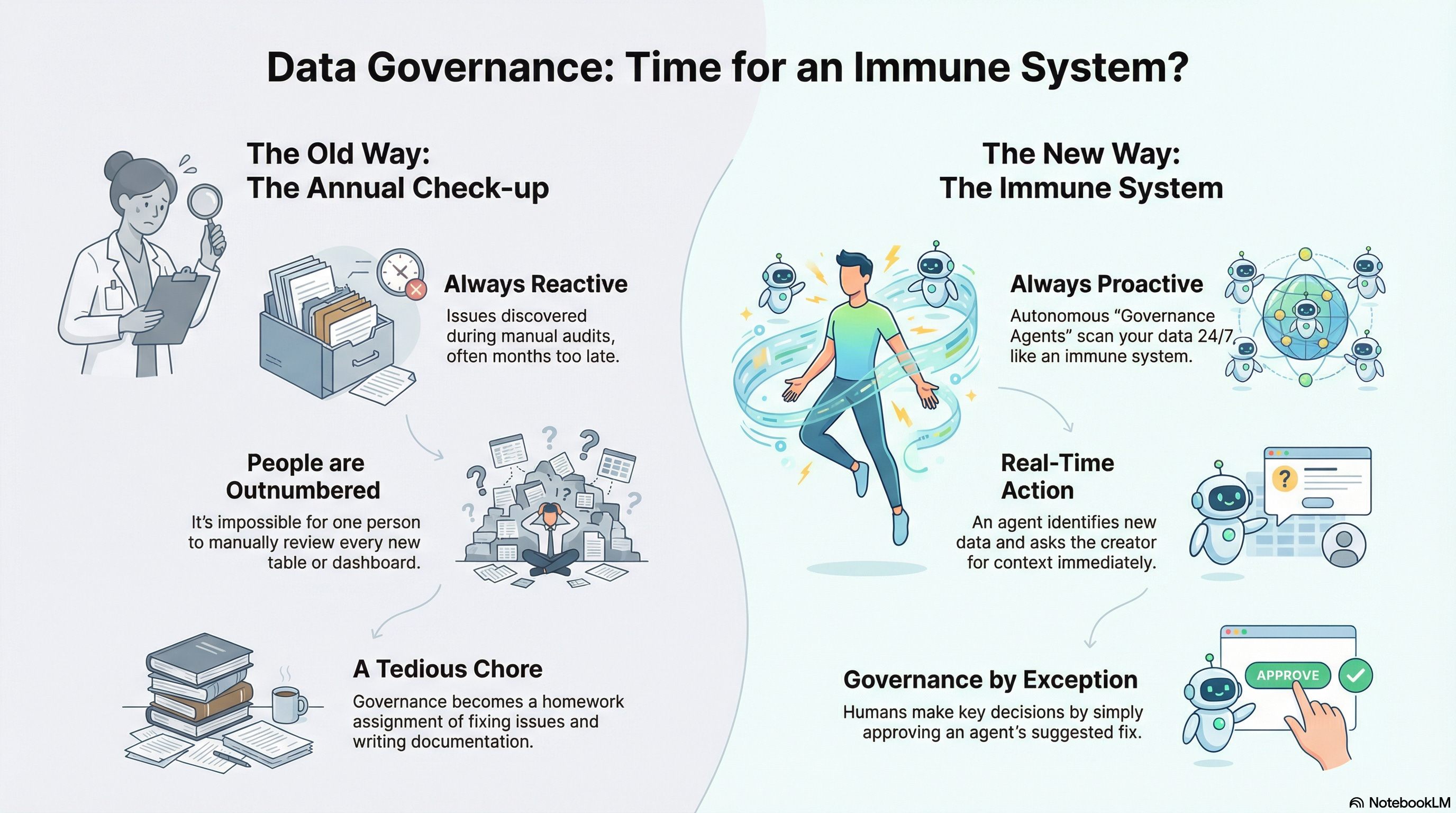
The “Immune System”
Think about how your body protects itself. You don’t consciously decide to fight every bacteria you breathe in. If you did, you would be overwhelmed in seconds. Instead, you have an Immune System. It works autonomously in the background. It detects foreign entities, neutralizes threats, and repairs cells—all in the background while you focus on real work. You (The Brain) only get involved when there’s a fever. And let’s be honest, in data governance, we’ve been living with a constant fever for years.
Traditional Data Governance is like going to the doctor once a year. It is manual, reactive, and often too late. (Of course there are some technologies that help us, make things less manual but the world has begun to change)
The Future of Governance is an Immune System. We need Governance Agents that act like “digital white blood cells”—scanning the ecosystem 24/7, fixing issues on the spot, and only waking up the human Steward when the “fever” gets too high.
Meet Your New Colleague: The Governance Agent
So, what would a “Governance Agent” actually do? Imagine an autonomous bot that lives in your Slack or Teams, has access to your Metadata, and has a clear goal: “Keep the Data Clean and Safe.”
It wouldn’t just enforce rules; it would negotiate them.
Use Case 1: The “New Data” Interrogator
Today: A Data Scientist creates a new table
USER_PRED_V2in the data lake. Six months later, you find it during an audit and ask: “What is this?” No one remembers.With a Governance Agent:
Agent detects new table creation.
Agent analyzes columns: “I see emails and credit scores.”
Agent pings the creator on Slack: “Hey Atacan, I noticed you created
USER_PRED_V2which looks like it has PII. Should I tag this as ‘Confidential’ and apply the masking policy? Or is this synthetic data?”Atacan replies: “Synthetic”
Agent: “Copy that. I’ve tagged it as ‘Synthetic/Public’. Thanks!”
Result: Documentation happens in the moment of creation, not 6 months later.
Use Case 2: The Policy Diplomat
Today: You write a policy: “All descriptions must be at least 50 characters.” No one reads it.
With a Governance Agent:
Agent scans the Data Catalog.
Agent finds a short description.
Agent drafts a better description using GenAI based on the column data.
Agent pings the Data Steward: “Hi Atlas, the description for
CUST_IDis too short. I drafted a better one for you: ‘Unique identifier for active customers in the EMEA region.’ Do you approve?”Atlas clicks: “Approve.”
Result: Governance becomes a “Yes/No” approval workflow, not a homework assignment.
And let’s not even get into the broken dashboards. We’ve all been there—CRM forms change, and suddenly the Director’s report is a mess. An agent fixes this in seconds, not after a week of emails.
The Future: Governance by Exception
This doesn’t mean we fire the Data Governance team. It means we promote them.
I know what you’re thinking: ‘Another agent to manage?’ But the alternative is being a data janitor for the rest of your career.
The Governance Agent brings you the evidence and a suggested fix.
You make the final judgment on complex, ethical, or strategic conflicts.
We are building a world filled with AI Agents.
The only way to manage a world of AI agents is with Governance Agents that are just as fast and never get bored of the details.
It’s time to build your organization’s immune system.
What did this article bring to mind for you? For what other purposes can we use the Governance Agent? I look forward to your comments.
All the best,
Atacan